
“You are a queen, and this is your game.”
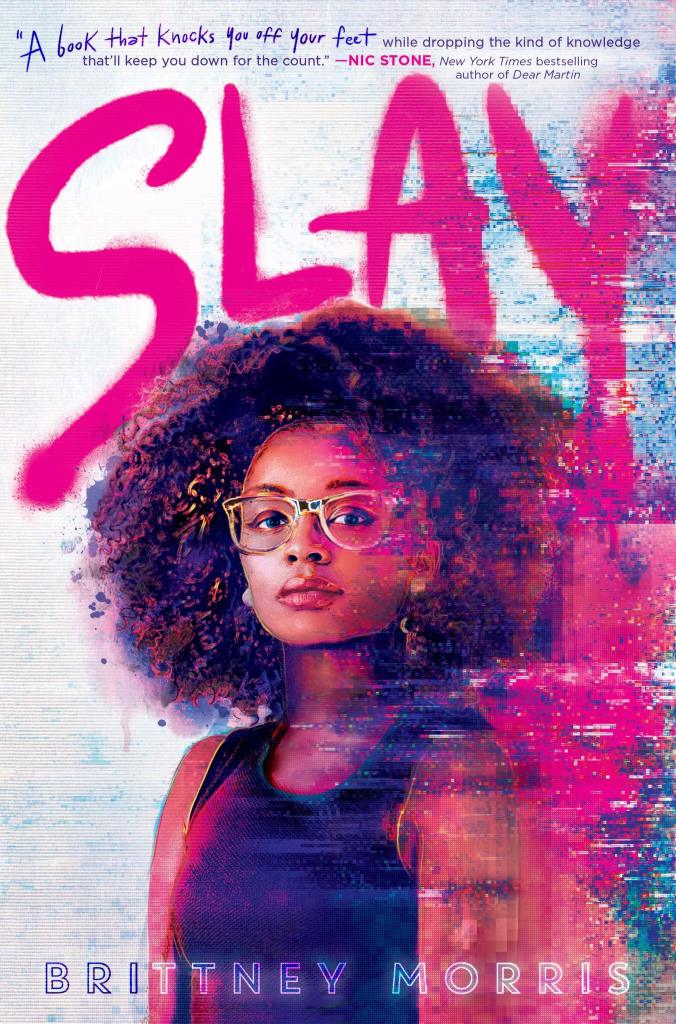

By day, seventeen-year-old Kiera Johnson is a college student, and one of the only black kids at Jefferson Academy. By night, she joins hundreds of thousands of black gamers who duel worldwide in the secret online role-playing card game, SLAY.
No one knows Kiera is the game developer – not even her boyfriend, Malcolm. But when a teen in Kansas City is murdered over a dispute in the SLAY world, the media labels it an exclusionist, racist hub for thugs.
With threats coming from both inside and outside the game, Kiera must fight to save the safe space she’s created. But can she protect SLAY without losing herself?

Welcome to Slay, a book described as The Hate U Give meets Ready Player One. I have to admit that this title has been sitting on my shelf waiting patiently to be read for over two years. I finally decided it was time to give it a read two weeks ago, and wow—I am glad I finally stepped into Kiera’s world.
Kiera is a 17-year-old high school student who secretly runs an MMORPG (massively multiplayer online role-playing game) known as Slay. Slay can be played in virtual reality with the help of a VR headset and gloves, but the VR equipment is optional (albeit playing without it is less immersive). The primary objective of the game is to challenge other players to duels to gain Slay coins and gear. Duels feature cards that each have unique abilities, and the cool thing about the cards is that each one is themed around black culture across the entire diaspora. For example, you could pull a card inspired by American black cultural icons such as Jimmy Hendrix or Gabby Douglas, and you can also pull cards related to ceremonies and traditions in Kenya. In all, the intention behind Slay is to create an online game inspired by black culture and a safe space for black gamers.
“We are a diaspora. We span hundreds of shades, religions, traditions, and cultural nuances. If you don’t understand what some of these cards mean, blame the slave trade.“
When formulating my thoughts for reviews, I often refer to other reviewers’ opinions to assess where my viewpoints align or diverge from the general consensus. After reading a number of ratings, I have to say that I strongly disagree with the primary critiques of this book. Most negative reviews of Slay claim that its simplicity prevents readers from having the desired reading experience. Many people cited that it is wholly implausible for Kiera to be the developer of this massive online community and keep her identity completely hidden from the world and those closest to her. While I do believe that the argument of plausibility is valid, I also think it should not be the primary focus of consideration.
Here’s my thing: extraordinary people do extraordinary things all the time—so what? This book begs bigger questions than “Can a 17-year-old girl realistically create this game?” Regardless of your opinion about the answer to that question, the rest book doesn’t change. Instead of dwelling on that, I directed my attention toward analyzing the genuine social commentary that this book holds space for.
Slay covers a lot of ground for a 300-page young adult novel. It describes what it feels like to be one of the very few black kids in a predominately white school. It shines a light on the internal pressure to be “great” and “upstanding” that many black Americans silently feel in childhood, adolescence, and—I’d argue especially—adulthood. It covers the strife that comes to black interpersonal relationships when black people feel differently about respectability politics. It unveils the covert racism in how blackness (ideas, attitudes, cultural norms, and more) is often falsely conflated with higher likelihoods of violence, and how relentlessly blackness is scrutinized when violence does occur in predominately black spaces. My point is that this book has big ideas written in easily accessible and relatable terms if you take enough time to pick it apart. It actually deeply saddens me that handfuls of people criticized and disregarded this book because of elements that I consider trivial in the grander message of the work.
“As we duel, as we chat, there’s an understanding that “your black is not my black” and “your weird is not my weird” and “your beautiful is not my beautiful,” and that’s okay. It’ brings tears to my eyes if I think about it too long.”
I have more thoughts on Slay that are not captured in this review for the sake of length. I am contemplating making a follow-up booktube video discussing more points of critique that I want to unpack. For now, I will wrap up by saying that I think this book is the epitome of how blackness is beautiful and complex. I think this book has the message of The Hate U Give and the heart of Black Girl Unlimited. I look forward to reading more work from Morris.


Discover more from Cierra's Cynosure
Subscribe to get the latest posts sent to your email.


