
“I believe one day you will understand that I was forced to make an impossible choice. A life in this death camp is no life at all. I chose to fight back, to find freedom in my resistance, to find liberation in the emancipation of others.”
Notice: Solis is a companion book to Sanctuary, whose events take place before the beginning of this novel. Read my review for Sanctuary here.
Notice: thank you to Penguin Teen for providing an advanced reader’s copy of this book through the Penguin Teen Partner Program. This does not affect my opinion.
Content warning: racism, xenophobia, homophobia, forced imprisonment, violence, explicit depictions of death.

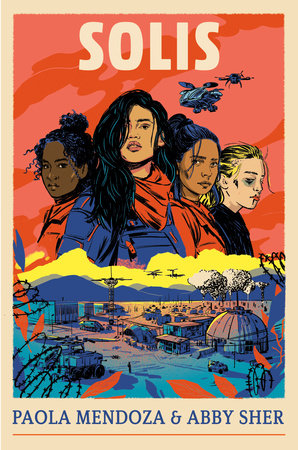
The year is 2033, and in this near-future America where undocumented people are forced into labor camps, life is bleak. Especially so for seventeen-year-old Rania, a Lebanese teenager from Chicago. When she and her mother were rounded up by the Deportation Force, they were given the brutal job of digging in the labor camp’s mine searching for the destructive and toxic, but potentially world-changing chemical, aqualinium. With this chemical, the corrupt and xenophobic government of the New American Republic could actually control the weather—ending devastating droughts sweeping the planet due to climate change. If the government succeeds, other countries would be at their mercy. Solidifying this power comes at the expense of the undocumented immigrants forced to endure horrendous conditions to mine the chemical or used in cruel experiments to test it, leaving their bodies wracked in extreme pain to the point of death. As the experiments ramp up, things only get worse. Rania and her fellow prisoners decide to start a revolution; if they don’t, they know they will die.
Told by four narrators—Rania, Jess (a former teenage Deportation Force officer), Vali, and Vali’s mother Liliana—Solis is about the courage and sacrifice it takes to stand and fight for freedom.

Solis picks up one year after the events of its companion novel, Sanctuary. I found that having read Sanctuary first, I had the clearest context for all of the character relationships and crossovers that continued into this title. Nevertheless, the authors do a great job at bringing readers up to speed about the overarching world events and connections we learned about from book one, and you end up in the same place regardless. I enjoyed the new element of the four main characters now telling the story from start to finish in their own chapters. I was a bit skeptical at first because following that many storylines can be challenging, but each character’s voice is resoundingly clear and their personalities are distinct.
Though brief, this book is dark and heavy. Mendoza and Sher unapologetically explore the depravity that occurs when corruption and bigotry fester in politics and climate change poses an ever-increasing threat to life. How an authoritarian political system takes hold as a result, and humans who present as “different” (read: anyone who is not a white U.S. citizen), are alienated and reduced to slaves. It is especially upsetting to be reviewing such work in present-day 2024, where we are on the cusp of yet another deeply consequential presidential election here in the United States, and we just passed the first anniversary of the world’s most digitally documented genocide taking place in Gaza.
Like Sanctuary, the message of Solis is loud and clear: the gross crimes against humanity depicted in this novel are not an impossibility. One critique of this title that I’ve pondered before writing this review is that the violence depicted is so extreme that it reads more like shock value and therefore dampens the impact. I’ve contended with this argument because I think there is some merit to it. For instance, in Sanctuary, the on-page corruption mirrored the anti-immigration political rhetoric that was circulating here in the States so closely that the corruption and violence felt domestically possible. However, the corruption and now extended depravity depicted in Solis feels so much like an extreme escalation that it no longer feels domestically possible. So if you’re an American reader reading this book and thinking, “That would never happen here,” I could see you sharing this criticism. However, a beautiful perspective I’ve gained from reading Mendoza and Sher’s work is that the violence they write about extends far beyond the United States. And so I want to be very careful with falling into that mindset, because even if it feels like this could never happen on U.S. soil, it can—and very much is—happen elsewhere in the world where it is endorsed by the U.S.
There are a lot of themes I could pick out and dissect in Solis, and I think that is why I am so drawn to Mendoza and Sher’s work. I did find myself feeling like I wanted more resolution by the end of the novel, though, because it ends rather abruptly. I wanted to learn what Jess’ plans were moving forward to continue dismantling the system she was part of. I wanted more opportunity to bask in the relief I felt when Vali and her mom Liliana were finally reconnected.
In all, Solis is an allegorical book that serves as a warning of what could happen when corruption and climate change go unchecked. If you’re looking for a thought-provoking, young adult political “dystopia” that will make you question the way the real world is heading, this is the book for you.


Discover more from Cierra's Cynosure
Subscribe to get the latest posts sent to your email.

 Cierra's Cynosure