“I am Deka, the Angoro. And I am coming for the gods.”
Notice: This is the second book in the Deathless trilogy. Read my review for book one here.

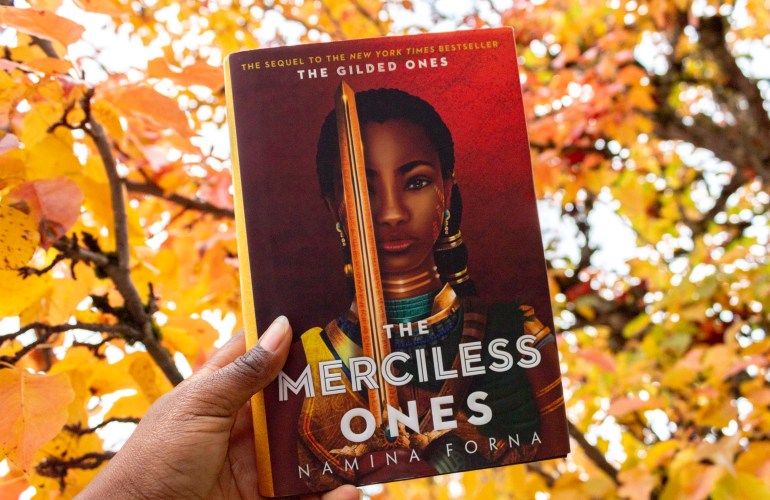
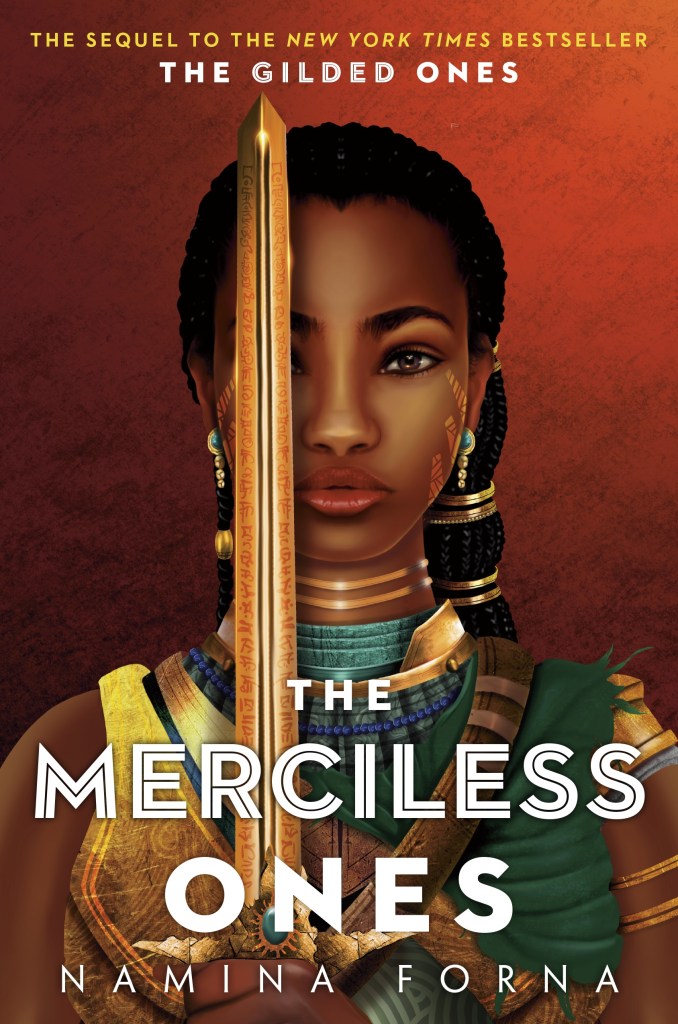
It’s been six months since Deka freed the goddesses in the ancient kingdom of Otera and discovered who she really is… but war is waging across the kingdom, and the real battle has only just begun. For there is a dark force growing in Otera—a merciless power that Deka and her army must stop. Yet hidden secrets threaten to destroy everything Deka has known. And with her own gifts changing, Deka must discover if she holds the key to saving Otera… or if she might be its greatest threat.

I first read The Gilded Ones back in January 2022. As a young black woman reader, I was ecstatic about the prospect of an action-packed, female-centered, YA fantasy with a black girl front and center leading us through it all. Unfortunately, my enthusiasm was tempered after reading the first book because I had a lot of criticisms. However, in the interest of giving the series a fair try and with the sequel publication fast approaching at the time, I decided I would pick up and read the next book when it came out.
It’s now September 2024, and I have finally gotten around to completing the second installment of what is now known as the Deathless trilogy (the third and final book in the series was published earlier this year). And well…whatever hope I had that book two would turn it all around for me is now lost. Let’s begin by recapping what went wrong in book one.
To summarize my grievances with The Gilded Ones, I found myself unable to connect with not only the world around the characters but also the characters themselves. So much of the first book consisted of Deka’s internal monologue about her fears and ruminations instead of contextualizing herself into her surroundings and building strong foundations for her relationships. Because of this, I felt extremely disconnected from the traumatic environment and circumstances that supposedly bonded our main cast of characters to Deka, which in turn led me to feel that they were there solely to be Deka’s foils (characters whose primary function is to accentuate her traits in the most uncreative ways ever). Here are some examples:
- Keita serves to accentuate Deka’s vulnerability because of his inability to access his own vulnerability. This is due to the classic, patriarchal, anti-women views of the world. And because, of course, he is her love interest. Boring.
- Britta serves to accentuate Deka’s unique talents/skills often by jokingly commenting on her own ineptness at the very thing Deka can do flawlessly. Also, Britta has a habit of quite literally spelling things out for Deka because she is her best friend. It’s giving, “I know you better than I know myself,” but in a way that is baseless and therefore annoying.
- Belcalis serves to accentuate Deka’s (increasingly rare) rationality because of her own tendency to be hot-headed and impulsive.
Because I felt like the character cast was primarily there to uplift Deka, I found it hard to care about any of them individually, let alone their supposedly deep connections to each other. This is really a hard pill for me to swallow because this series is so highly praised for its “found family” trope and spotlight on close friendships. Unfortunately, I couldn’t feel more different.
So those were the grievances that I noted in book one. Much to my dismay, all of them have remained in place during my reading experience with The Merciless Ones, and what’s worse is that this second title has added two new grievances to my list. So let’s discuss.

If I had to summarize how I feel about The Merciless Ones in a few words, I would say that it is a book that tries to do too much and therefore ends up doing nothing. Here lies my first grievance: the book is overly ambitious to an extreme fault. After 400+ pages, the only significant plot progression that happens is 1) it is revealed that The Gilded Ones are not the only gods of Otera and that they are not the benevolent mothers we thought them to be, and 2) Deka is more powerful and unstoppable than ever (more on that later). That’s literally it.
I saw a reviewer’s commentary that middle books in a trilogy are usually of two natures: climaxes or connectors. They classified The Merciless Ones as a connector and I couldn’t agree more. This book is a hodgepodge of subplots that either end up going nowhere or simply shuffle the characters along to their next hint that the mothers aren’t what they thought they were. And what truly irks me the most about this is that connector books are not inherently doomed to be filler. For example, Girls of Storm and Shadow is a fantastic connector book in the Girls of Paper and Fire trilogy.
I’m really disappointed with how much I struggled to follow the narrative structure of this middle title. As many critical reviewers mentioned, finding artifacts with special powers called arcane objects becomes a driving force of this book despite being rather confusing. For how dire the consequences are if they are not located and wielded appropriately by our characters, it also felt like we never got a straight answer as to what they actually are. Upon reflection, it seems to me that this was an intentional act by Forna to try to foreshadow what I could only think was supposed to be a big plot twist. But even after reading the entire book, I’m still confused.
For example, there is one major arcane object called the angoro that kicks off the entire book. Deka returns to the mothers after one of the first battles to report to them about the kaduth symbol she’s seeing on the jatu that blocks her powers. In turn, the mothers divulge to Deka that the angoro is a supreme power source that she needs to go find that would help her overcome the kaduth. Well, by the end of the book it is revealed that Deka herself is the angoro. And if you’re anything like me, you might be saying to yourself “Wait, what?” And well…yeah, same. I don’t get it either. If I excavate for meaning, I think the point was to really drive home how cunning the mothers are and expose the lengths they went to control Deka. It could also serve to highlight the overarching theme of betrayal throughout the series so far, but eh—I shouldn’t have to do mental gymnastics to understand the “gotcha” moment. It defeats the purpose.
Finally, let’s talk about Deka’s powers. One of my most disliked literary tropes is the unstoppable main character. If you haven’t encountered this before, it’s when the main character of a work has unlimited power and always comes out on top despite all odds. While it is fun as a reader to root for your main character when you’re attached to them, it also diminishes any perceived stakes for your character to come up against. This, in turn, hinders character growth and leads to a main character who is so used to winning that they aren’t forced to try something new. My second grievance is that Deka suffers from extreme unstoppable main character energy in The Merciless Ones. There are countless battles that she effortlessly conquers even when it is entirely inconceivable for her to do so. One particularly egregious example comes to mind:
“And the first wave of men comes rushing forward. Even before they near, red has hazed my vision, instinct immediately replacing thought. I’m a blur of motion as I cleave the nearest jatu straight through the middle, then move on to the next one. Within moments, sound and color blur, heads rolling, arms flying, blood and viscera spraying the air. A distant pain stabs through one of my arms, and I look down to find it almost completely severed. I jerk it back into place before continuing on, cutting a swathe with my atikas.”
…Girl what? How do you just continue on in a solo battle against multiple waves of men with an arm that is nearly severed? It is not lost on me that Deka is discovering that her already superhuman abilities are becoming even more superhuman during this particular battle, but come on. This scene is the perfect example of what is wrong with an unstoppable main character: not only is it utterly unrealistic to be able to continue waging total warfare with an injury this severe, but it is also unimaginative on the author’s end because she misses an opportunity to craft circumstances that could allow Deka to recover plausibly.
And so I challenge you: imagine a 400-page book filled with variations of this scene over and over again, combined with a world you can’t picture featuring characters that you don’t care about, and now you see why I dislike this book so much.

To be fair, Deka does come up against grave stakes in the very last chapter of this book which serves as the connecting piece to the third and final book of the series, The Eternal Ones. But if I’m being honest here friends, I do not foresee myself finishing this series. I gave this book a try to see if my opinion would change for the better but it has only gotten worse. This is not the series for me, but if you’re looking for a YA fantasy featuring gods, betrayal, found family, and a whole lot of gory battles, this may be the one for you.

Discover more from Cierra's Cynosure
Subscribe to get the latest posts sent to your email.

 Cierra's Cynosure
Amazing review!!
LikeLike