
“I know who I am. I don’t need to be more hearing or prove my deafness. I can bring both worlds together. Just being myself, I’m complete.”
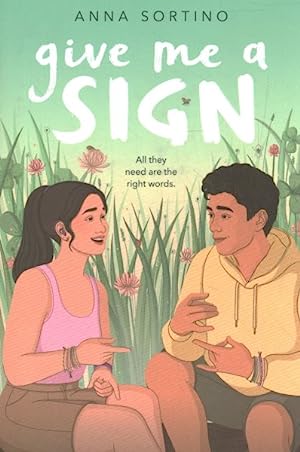

A girl finds a community—and love—over the course of one summer in this joyful, wholesome YA romance that celebrates Deaf pride. Think CODA meets Jenny Han!
Lilah is tired of being stuck in the middle. At least, that’s what having a hearing loss seems like sometimes—when you don’t feel “deaf enough” to identify as Deaf or hearing enough to meet the world’s expectations.
Ready for a change, Lilah becomes a counselor at a summer camp for the deaf and blind, where she plans to brush up on her ASL. There, she also finds a community. There are British lifeguards, who are very cute and very hard to understand; a YouTuber, who’s just a bit desperate for clout; the campers Lilah’s responsible for (and maybe a bit overwhelmed by)—and there’s Isaac, the dreamy Deaf counselor who volunteers to help Lilah with her signing.
Romance was never on the agenda, and Lilah’s not positive Isaac likes her that way. But all signs seem to point to love—unless Lilah’s reading them wrong? One thing’s for sure: Lilah wanted change, and things here…they’re definitely different than she’s used to.
Notice: thank you to Penguin Teen for sending an advanced reader’s copy of this book through the Penguin Teen Partner Program. This does not affect my opinion.
Give Me a Sign is a heartwarming summer novel that brings the complexities of deaf culture to the forefront of young adult fiction. Our main character Lilah is a deaf teenager beginning her summer break from high school. Lilah lands a job as a junior camp counselor at Gray Wolf, a free summer camp for deaf and blind kids of all ages. She’s delighted to have landed this job because she was once a camper at Gray Wolf herself. At the beginning of the book, we witness her reminisce on how positive the camp experience was for her, and how comparatively, the “hearing world” is full of accessibility challenges on a daily basis.
As the synopsis suggests, Lilah feels caught in the middle of two worlds: she is not profoundly deaf, but she is deaf enough that daily interactions are difficult. She has hearing aids, but they don’t magically fix her hearing. Regardless of these facts, the people around her have expectations for her to keep up and function “normally” despite her disability.
“I’m not ashamed of my disability or anything like that. What bothers me is trying to fit into the hearing world. That I’m constantly the odd one out, the one who always has to explain or adjust.”
In contrast, at Camp, she is able to be herself without the hearing world’s expectations. She is immersed in and determined to improve American sign language. She can forgo the hearing aids if she wants to. She doesn’t have to worry about being considered “annoying” for asking someone to repeat themselves or rephrase their words so that she understands. And while the accessibility/accommodation troubles fall away, Lilah finds herself falling for another dead camp counselor, Isaac.
What I appreciated most about Give Me a Sign is how each character is unique and their experiences and backgrounds with being deaf/HoH/blind are spotlighted in turn. We see a real representation of a disability spectrum: a spectrum of deafness; a spectrum of ASL fluency; a spectrum of independence and confidence in navigating the world with these disabilities. Not every character likes being loud and proud about their disability; not every character signs; not every character wears or enjoys wearing their hearing devices. In Sortino’s author note at the end of the book, she touches on how diverse the disability experience is, and how even the diverse cast of Give Me a Sign will never encompass every person’s experience with deafness:
“Give Me a Sign is by no means representative of all those with hearing loss, since no single novel could possibly encompass our variety of backgrounds and stories. I simply hope it gives readers a glance into the deoth and complexities of Deaf culture, as well as an understanding of why I and so many others are proud to be Deaf.”
– Anna Sortino
In all, I have a great appreciation for this book and its exploration of disability in the young adult novel space. It has its happy, sad, infuriating, and enlightening moments all throughout, and I think for anyone and everyone, it’s worth the read.


Discover more from Cierra's Cynosure
Subscribe to get the latest posts sent to your email.

 Cierra's Cynosure